

If your VMware renewal is due in the next year, price Proxmox VE before you sign. Take a common setup: three hosts, each with two 16-core CPUs. VMware licenses that by the core, 96 of them. Proxmox charges by the socket, six of them, which comes to about HK$19,200 a year with Basic support or HK$28,500 with Standard. At the widely reported list price for vSphere Foundation, about US$135 a core, the VMware side is roughly HK$101,800 a year.
Whether that's a saving for you depends on your quote, so there's a calculator below for your own numbers. I've written this for the two people who usually end up with that quote on their desk: the IT head who has to run whatever is chosen, and the procurement lead who has to sign for it. It covers what changed, what Proxmox does well, the full cost rather than just the licences, and where a move tends to trip up.
What changed with VMware?
In December 2023 Broadcom stopped selling perpetual licences and moved customers to subscription bundles, mainly VMware Cloud Foundation (VCF) and VMware vSphere Foundation (VVF). Every CPU is licensed by its cores, with a minimum of 16 per CPU. A host with two 8-core CPUs is licensed for 32 cores, not 16.
For large customers the jumps have been big. AT&T told a New York court it was quoted a 1,050% increase, and European cloud providers in the CISPE trade body reported rises of 800% to 1,500%. Broadcom has also added options for smaller sites, most recently vSphere Express in November 2026, sized for up to 128 cores. Get a quote for it too, so you're comparing the real alternatives.
Is Proxmox ready for production?
For most general workloads, yes. Proxmox VE is an open-source virtualisation platform from Proxmox Server Solutions in Vienna, built on KVM for virtual machines and LXC for containers. Version 9.2 came out in May 2026, and Proxmox says it runs on more than 2 million hosts.
The features most VMware shops use every day are there:
| You use in VMware | In Proxmox VE | Worth knowing |
|---|---|---|
| ESXi | Proxmox VE (KVM) | One install per host, managed from a web console |
| vCenter | The cluster's own web console; Proxmox Datacenter Manager across clusters | Datacenter Manager 1.0 shipped in December 2025 |
| vMotion | Live migration | Between hosts in a cluster, and across clusters with Datacenter Manager |
| HA | HA manager | Needs three hosts, or two plus a small quorum device |
| DRS | Dynamic load balancer | New in 9.2 |
| vSAN | Ceph | vSAN disks can't be imported directly |
| NSX | Software-defined networking (VNets, EVPN) | Does a similar job with a different design |
| Backup | Proxmox Backup Server, or Veeam | Veeam has supported Proxmox VE since 12.2 (2024) |
The software is free under the AGPL v3. What you pay for is a yearly subscription per CPU socket, which gives you the tested enterprise updates and, from Basic upwards, support tickets with Proxmox.
What will it cost you?
Proxmox prices each CPU socket per year, whatever its core count. It publishes its prices in euros; in Hong Kong dollars they come to about HK$1,040 for Community (updates, no support tickets), HK$3,200 for Basic, HK$4,750 for Standard and HK$9,510 for Premium, which has had 24/7 support since October 2026. VMware counts cores. The gap is widest on hosts with lots of cores per CPU.
Try it with your own numbers. Broadcom doesn't publish a price list, so the calculator starts from the widely reported list price for vSphere Foundation, about US$135 (HK$1,060) per core per year. Real quotes vary a lot from firm to firm, so replace it with the figure from yours.
Yearly licence cost: VMware vs Proxmox VE
Per occupied CPU socket, at Proxmox's published euro price, converted to HK$.
Licences only. Exchange rate: ECB, 16 November 2026; change it to today's. VMware rules: 16-core minimum per CPU (Broadcom KB 313548). VMware prices are an assumption: Broadcom publishes no price list, and these are the widely reported list prices of about US$135 (vSphere Foundation) and US$350 (Cloud Foundation) per core per year, converted at the ECB rate. Real quotes vary, so use yours. Proxmox prices: proxmox.com, November 2026.
What goes in the business case?
Licences are the easy line to compare, and they aren't the whole bill. Procurement will want the rest on the same page, over the three to five years you'd keep the platform:
| Cost line | What to ask |
|---|---|
| Licences | VMware: cores × your per-core price × the term. Proxmox: sockets × the support level you pick. |
| Support | Who answers a critical call, and how fast? Proxmox Premium has been 24/7 since October 2026; Standard promises a 4-hour response to critical issues. |
| Hardware | Can the current hosts be reused? Check them against Proxmox's requirements before budgeting new ones. |
| Storage | Moving off vSAN means Ceph or an existing SAN. Price the disks and network that need. |
| Backup | Does your backup tool cover Proxmox? Veeam does from version 12.2, or use Proxmox Backup Server. |
| Migration | The one-off project: assessment, design, the moves themselves, and staff time. |
| Skills | Training for the team that will run it day to day. |
| Parallel run | Months of running both platforms while the waves move. Line the plan up with your renewal date. |
A parallel run is a hidden cost to watch for. If most VMs will have moved within a year, ask your VMware partner what a shorter term or a smaller core count would cost, rather than renewing everything for three years.
Where migrations trip up
Proxmox has had an import wizard since version 8.2 in 2024. It connects to an ESXi host, maps the VM's settings and brings it across, and it can even start the VM while the data is still copying. Most of the problems are known in advance, and Proxmox lists them in its own migration guide:
- BitLocker. The vTPM state can't be moved from VMware. Turn off BitLocker, or any similar disk encryption, before the move and keep the recovery keys, or the VM won't boot.
- Drivers. Remove VMware Tools first. Windows boots only from IDE or SATA until the VirtIO drivers are installed, and the QEMU guest agent takes over from VMware Tools.
- Network cards. The VM gets a new network card with a new MAC address. Static IP settings need re-entering, and DHCP reservations need updating.
- vSAN and encrypted disks. The wizard can't read them, so move those disks to other storage first.
- Snapshots. Remove them before the import, as they slow it down a lot.
- Live import. If it fails halfway, everything written since it started is lost. Keep it for VMs that can afford that.
- The cluster. High availability needs at least three hosts, or two plus a quorum device, and a separate network for cluster traffic.
Each of these is an hour of preparation, or a long night if you find it halfway through.
You don't have to move everything
In September 2025 Gartner said VMware would lose about 35% of its workloads within three years. It also advised against planning to move everything: a full migration takes three years or more, and moving the applications that are ready first pays off sooner.
In practice, the general workloads go first: file servers, internal applications, test and development. Some systems stay, for now, such as vendor appliances or applications whose support is only certified on VMware. Ask those vendors when they'll support Proxmox, and look again at each renewal. Running both platforms for a while is normal, and a smaller VMware footprint usually means a smaller renewal.
How we run a move
We work in five steps, from the first inventory to looking after the new platform.
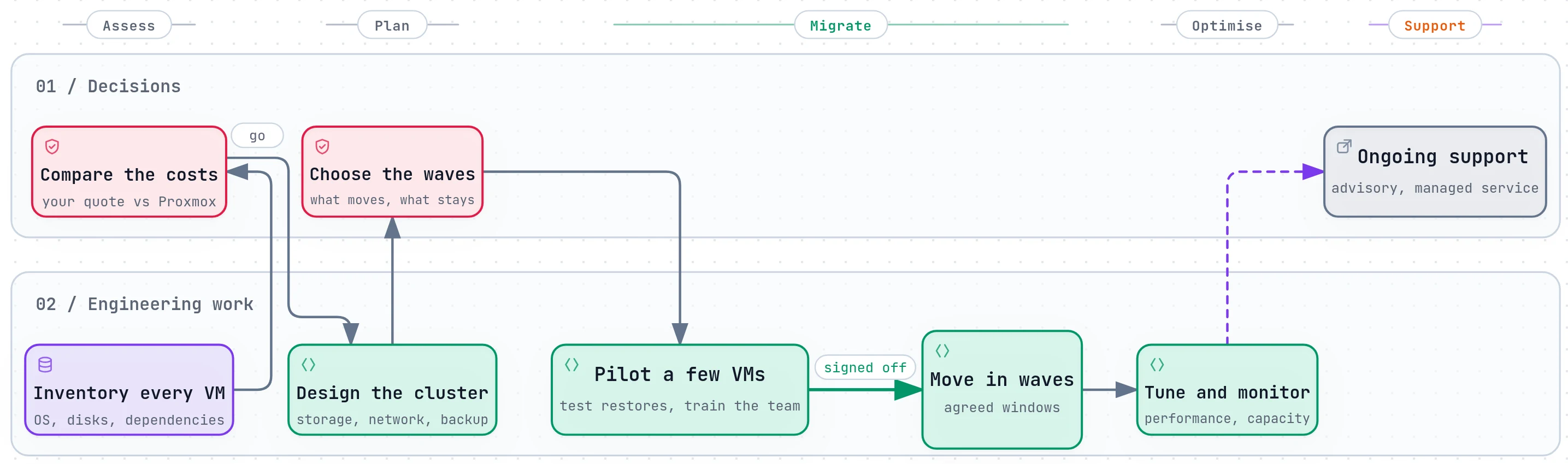
- Assess. We inventory every VM: its operating system, disks, dependencies and licences, and which ones use vTPM, BitLocker or vSAN. You get a cost comparison built on your real quote, and a list of what should move and what should stay.
- Plan. We design the Proxmox cluster, its storage (Ceph or your existing SAN), networking and backups, and agree the order of the waves with you.
- Migrate. A few low-risk VMs go first, so the team can test backups and restores and get used to the console. Then the rest move in waves, in agreed windows, with each original VM kept on VMware until you sign it off.
- Optimise. We tune performance and set up monitoring and capacity planning, so the cluster has room to grow.
- Support. We stay on for advice, or run the platform for you as a managed service.
Proxmox runs on infrastructure you control, which suits teams that want to keep workloads in their own data centre. Our on-premise and hybrid cloud work builds, secures and monitors every environment to the same standard, so the new cluster doesn't become another island.
If your renewal is coming up, book a 20-minute call or request an Architecture Review. It's easier to decide with your own numbers in front of you.
Sources
- Broadcom, Counting Cores for VMware Cloud Foundation and vSphere Foundation and TiBs for vSAN, KB 313548
- The Register, Broadcom halves sub price for VMware's flagship hybrid cloud (the end of perpetual licences), 12 December 2023
- VMware Cloud Foundation blog, Broadcom updates VMware portfolio to protect and accelerate private AI cloud deployments, 4 November 2026
- The Register, AT&T claims VMware offered it a 1,050 percent price rise, 1 October 2024
- CISPE, ECCO reports no progress with Broadcom, 22 May 2025
- The Register, VMware to lose 35 percent of workloads in three years, 11 September 2025
- Proxmox, Proxmox Virtual Environment 9.2 with Dynamic Load Balancer released, 21 May 2026
- Proxmox, Proxmox Virtual Environment 8.2 with Import Wizard released, 24 April 2024
- Proxmox, Proxmox Datacenter Manager 1.0, 4 December 2025
- European Central Bank, euro foreign exchange reference rates: €1 = HK$8.6427, 16 November 2026
- MetroCo Advisory, VMware licensing and pricing: VCF vs VVF cost calculator (reported list prices; Broadcom publishes none), checked 17 November 2026
- Proxmox, Proxmox VE pricing, checked 17 November 2026
- Proxmox wiki, Migrate to Proxmox VE
- Veeam, KB4600: Release information for Veeam Backup & Replication 12.2, August 2024